

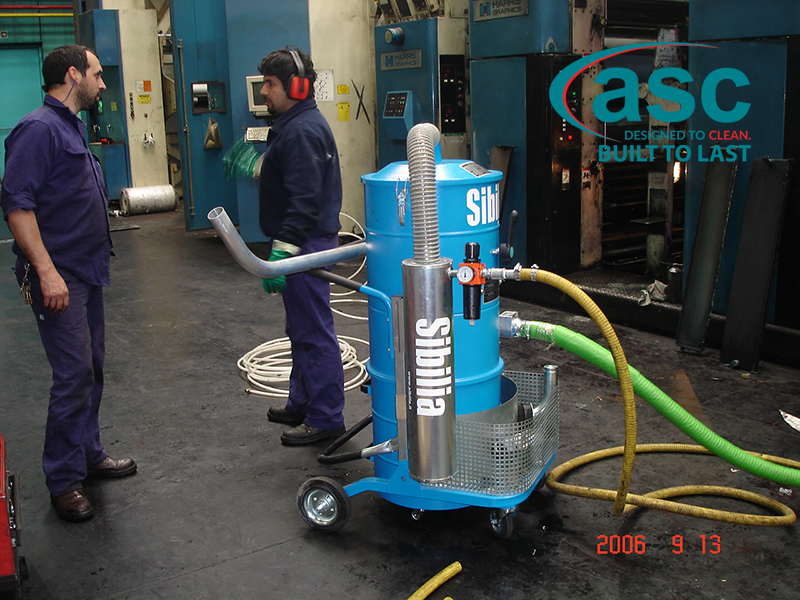
In commercial facilities like 3PL warehouses, food and beverage plants, rail depots, and OEM workshops, dust and light debris build up fast. Compact industrial vacuum cleaners enable teams to respond immediately. They are ideal for:
- Line-side and aisle-end clean-ups between shifts.
- Maintenance bays and tool rooms with tight clearances.
- Loading dock spill control, like cleaning granules, powders, and light chips, with options for liquids.
What exactly counts as an “industrial” compact vacuum?
Industrial compact vacuum cleaners are built for continuous duty, higher vacuum/airflow curves, robust filtration, and safer handling of powders. Key differences from domestic units include:
- Industrial turbines/side-channel pumps sized for long runs.
- Filtration stack including pre-filters plus fine filters; H-class/HEPA wherever required by your risk assessment. However, it is important to note that WorkSafe QLD mentions that HEPA alone doesn’t automatically equal H-class.
- Antistatic & earthing to manage static when moving dry powders.
- Ingress protection & safety options like IP-rated housings, overfill shut-offs, and for some models, ATEX/IECEx suitability in Zone 22 dust areas.
What are the best practices when selecting and using a compact vacuum cleaner
1) Do classify your dust before you buy
Identify materials like flour, grain dust, metal fines, plastics, RCS silica, and more, and consult exposure standards and your PCBU’s risk assessment. Safe Work Australia’s current Workplace Exposure Standards (2024) is a great starting point.
2) Do match the machine to the dust class and zone of your space
Use M- or H-class filtration for hazardous dusts as required. In any combustible dust environment, verify the area classification (20/21/22) and select equipment appropriately. CSIRO’s 2024 technical guide outlines zoning fundamentals under AS/NZS 60079.10.2.
3) Do specify multi-stage filtration and a sealed path
Look for a robust pre-filter, including a fine filter, where your risk assessment demands it. Include HEPA (H13/H14) within an H-class system where necessary. Remember: HEPA is not the same as H-class by itself, which is a common misconception.
4) Do train operators keep records
Document pre-start checks, filter changeouts, and drum emptying procedures. Align your SOPs with your WHS obligations and the Model WHS Regulations (Consolidated 2024).
ASC 1505 compact vacuum cleaner for industry
For sites wanting a nimble warehouse vacuum cleaner that still punches above its size, the ASC 1505 is a strong fit. This machine is designed for industries that need reliable, continuous cleaning performance without compromising on maneuverability.
Highlights include:
- A side-channel pump for continuous duty, ensuring uninterrupted suction power during long shifts.
- An optional liquid level sensor for safe and efficient wet pick-ups, making it suitable for both dry debris and liquid spills.
- ATEX Zone 22 certification, making it safe to use in environments with combustible dust.
- A low 75 dB(A) noise level, allowing operation in noise-sensitive areas without disturbing staff or production.
- A compact chassis that’s easy to steer around racks, aisles, and work cells.
Built for Industrial Demands
The ASC 1505 is engineered for tough conditions. From warehouses to production plants, its durable build and reliable components ensure long service life with minimal maintenance requirements. The machine is quiet, which makes it ideal for facilities where both cleanliness and comfort matter.
Where the ASC 1505 Excels
The ASC 1505 is versatile and suitable for a wide range of industries, including:
- Warehousing & logistics – for keeping aisles and racks dust-free.
- Food & beverage production – safe cleaning in areas requiring hygiene and dust control.
- Pharmaceutical & chemical plants – thanks to its ATEX Zone 22 compliance.
- Manufacturing & fabrication workshops – tackling fine dust, metal shavings, and production waste.
Why Choose the ASC 1505?
With its small footprint, strong suction power, and industrial-grade reliability, the ASC 1505 provides an excellent balance of performance and efficiency. It reduces downtime, improves workplace safety, and supports compliance in regulated environments.
Bottom Line
Used correctly, a compact, Zone-rated, M/H-Class-ready vacuum helps you reduce airborne dust, keep aisles safe, and cut downtime, while complementing your larger sweepers and scrubbers.
Follow the do’s and don’ts above, and if you want a proven option, explore the ASC 1505 compact vacuum cleaner and book a demo with ASC to match the setup to your site.
Practical FAQs
1) Can a compact vacuum cleaner handle silica dust?
Yes, but only if it meets your risk assessment and jurisdictional requirements. Australia introduced stronger regulations around processing crystalline silica substances from September 1, 2024.
2) What does “Zone 22” mean for vacuums?
Zone 22 signifies areas where combustible dust is not likely to be produced in normal operation but may happen occasionally. Equipment used there should be rated or constructed accordingly. Choose a compact vacuum cleaner explicitly suitable for Zone 22 when your classification demands it.
3) Is HEPA the same as H-class?
No, they are not. HEPA describes filter efficiency, whereas H-class is a machine classification for handling hazardous dusts; a unit can have HEPA yet not be certified H-class. Verify both filter specification and machine class.
4) Can one unit do dry and wet pick-up?
Yes, but only if fitted with the right parts or if the right control options are chosen. For example, the ASC 1505 can be specified with a liquid level sensor and shut-off to safely collect liquids. Never attempt wet pick-up on a dry-only configuration vacuum cleaner.